
بسم الله الرحمن الرحيم
Abū Hurayrah narrated from the Messenger of Allāh (ﷺ):
كُلُّ عَمَلِ ابْنِ آدَمَ يُضَاعَفُ الْحَسَنَةُ بِعَشْرِ أَمْثَالِهَا إِلَى سَبْعِمِائَةِ ضِعْفٍ، قَالَ اللَّهُ تَعَالَى: إِلَّا الصَّوْمَ فَإِنَّهُ لِي وَأَنَا أَجْزِي بِهِ ، يَدَعُ شَهْوَتَهُ وَطَعَامَهُ مِنْ أَجْلِي لِلصَّائِمِ فَرْحَتَانِ : فَرْحَةٌ عِنْدَ فِطْرِهِ، وَفَرْحَةٌ عِنْدَ لِقَاءِ رَبِّهِ ، وَلَخُلُوفُ فَمِ الصَّائِمِ أَطْيَبُ عِنْدَ اللَّهِ مِنْ رِيحِ الْمِسْكِ، وَالصِّيَامُ جُنَّةٌ ، وَإِذَا كَانَ يَوْمُ صَوْمٍ أَحَدِكُمْ فَلَا يَرْفُثْ وَلَا يَصْخَبُ ، فَإِنْ سَابَّهُ أَحَدٌ أَوْ قَاتَلَهُ فَلْيَقُلْ : إِنِّي امْرُؤٌ صَائِمٌ
“Every deed of the son of Ādam is multiplied — a good deed (rewarded) tenfold up to seven hundred times. Allāh The Most-High said: ‘Except fasting, for it is Mine and I (Myself) give recompense for it. He forsakes his desire and his food for My sake.’ For the one who fasts there are two joys: a joy at his breaking of the fast, and a joy at meeting his Lord. And the breath-change of the fasting person’s mouth is more pleasing to Allāh than the scent of musk. And fasting is a shield. And when any one of you has a day of fasting, let him not engage in obscene speech nor shout; and if anyone insults him or tries to fight him, let him say: I am a man who is fasting.'” (Sahīh al-Bukhārī 1904 and Sahīh Muslim 1151)
Imām al-Mubārakfūrī said: (Every deed of the son of Ādam) – al-Qārī said: meaning: every righteous deed of the son of Ādam — (is multiplied) meaning: its reward, as a favour from Him, The Most-High.
(Tenfold) — based on His saying The Most-High:
مَن جَاءَ بِالْحَسَنَةِ فَلَهُ عَشْرُ أَمْثَالِهَا
“Whoever comes with a good deed, for him is (a reward of) ten times the like thereof” (al-Anʿām: 160) — and this is the minimum of the multiplication, for otherwise it may be increased further.
(Up to seven hundred times) – meaning: the like (of it), rather up to many multiples, as (comes) in the revealed (Book):
مَن ذَا الَّذِي يُقْرِضُ اللَّهَ قَرْضًا حَسَنًا فَيُضَاعِفَهُ لَهُ أَضْعَافًا
“Who is it that will lend to Allāh a goodly loan so that He may multiply it for him many times over?” (al-Baqarah: 245) — and as occurs in (another) narration with the additional words: “up to whatever Allāh The Most-High wills.”
(Except fasting) – The meaning (being): the good deeds are multiplied in reward from tenfold up to seven hundred times, except fasting — for it is not multiplied up to this extent; rather, its reward is beyond measure and cannot be enumerated except by Allāh The Most-High.
(For it is Mine and I (Myself) give recompense for it) – meaning: fasting is a secret between Me and My servant; he performs it sincerely for My sake, seeking My Face, and the servants cannot perceive it, for fasting has no outward form in existence, unlike other acts of worship. And I (am) the One who knows its recompense; I take it upon Myself of giving its recompense and do not delegate it to another. And in this is an indication of the magnification of the gift and the greatness of the recompense, and that the multiplication of the reward of fasting is without number or reckoning.
(He forsakes his desire) – meaning: he abandons what his soul desires from among the things forbidden during fasting. And this is the rationale for its being singled out with a great recompense.
(And his food) – (this is) specification after generalisation; or alternatively, desire is a metonymy for sexual intercourse, and food is an expression for the rest of the things that break the fast.
And in (another) narration food is placed before desire. And (in the narration of) Ibn Khuzaymah [1897, Sahīh]: “He forsakes food and drink for My sake, and he forsakes his pleasure for My sake, and he forsakes his wife for My sake” — and this is explicit in indicating that what is meant by “desire” is the desire for sexual intercourse. And even more explicit is what is found in the narration of al-Hāfidh Samawayh: “He forsakes his desire for food, drink, and sexual intercourse.”
(For My sake) — meaning: for the sake of complying with My command and intending My pleasure and My reward.
(For the one who fasts there are two joys) — meaning: two great instances of joy: one in this world and the other in the next.
(A joy at his breaking of the fast) — meaning: at his breaking the fast — either by (the sense of) fulfilling the obligation commanded of him, or by finding the success granted to him in completing the fast, or by the soundness of the fast and its safety from corruptors, obscene speech, and idle talk, or by what he hopes for in terms of attaining the reward, or by eating and drinking after hunger and thirst.
Al-Qurtubī said: Its meaning is: he rejoices at the departure of his hunger and thirst, now that breaking the fast has been made lawful to him — and this joy is natural and is what first comes to mind. And it was said: his joy at breaking the fast is due to the fact that it marks the completion of his fast and the conclusion of his act of worship, an easing from his Lord, and an aid toward his future fasting.
Al-Hāfidh said: And there is nothing preventing a broader understanding than what was mentioned, for the joy of each person is according to his (spiritual) station, as people differ in their ranks in this regard. Some have a permissible joy — which is the natural (joy) — and some have a praiseworthy joy — which is the one whose cause is one of the things mentioned.
(And a joy at meeting his Lord) — meaning: by receiving the recompense, or by attaining the meeting (with Allāh). And it was said: it is the delight (arising from) the acceptance of his fast and the consequent abundant recompense accorded to him.
(And the breath-change, al-khulūf, of the fasting person’s mouth) — And they are agreed that what is meant is the change in the smell of the fasting person’s mouth due to fasting, as stated in “al-Fath.”
Al-Bājī said: al-khulūf: the change in the smell of the fasting person’s mouth, and it arises from the emptiness of the stomach due to leaving food, and it does not go away with the tooth-stick (siwāk), for it is the smell of the breath coming from the stomach — and what the siwāk removes is only the change caused by food residue in the teeth.
And al-Burqī said: It is the change of the taste and smell of the mouth due to the delay of food.
(Is more pleasing to Allāh than the scent of musk) — meaning: the possessor of the breath-change is more pleasing to Allāh, more acceptable, more esteemed, and nearer to Him The Most-High, than the possessor of musk is on account of its smell to you; and He The Most-High turns more toward him on account of it than you turn toward the possessor of musk on account of it. And in a wording of Muslim and al-Nasāʾī: “More pleasing to Allāh on the Day of Resurrection.“
And there arose a disagreement between Ibn al-Salāh and Ibn ʿAbd al-Salām as to whether the pleasantness of the breath-change applies in this world and the next, or in the next life only.
Ibn ʿAbd al-Salām held that it is in the next life, as with the blood of the martyr, and cited as evidence this narration of Muslim and al-Nasāʾī. And Abū al-Shaykh narrated — via a chain containing weakness — from Anas in a raised report: “The fasting ones will emerge from their graves, recognised by the smell of their mouths, and their mouths are more pleasing to Allāh than the scent of musk.”
And Ibn al-Salāh held that it is in this world and the next together, citing as evidence the narration: “And the breath-change of the fasting person’s mouth, at the time it changes from (the absence of) food, is more pleasing to Allāh than the scent of musk.” Al-Walī al-ʿIrāqī said: This narration is apparently indicating that its pleasantness applies in that very state, and interpreting it to mean that it is merely a cause for pleasantness in a future state is an interpretation contrary to the apparent meaning. And supporting this is what al-Ḥasan ibn Sufyān narrated in his “Musnad” and al-Bayhaqī in “al-Shuʿab” from a hadīth of Jābir — within a raised hadīth on the merits of this ummah in Ramadān — “As for the second: the breath-change of their mouths at the time of the evening is more pleasing to Allāh than the scent of musk.“
(And fasting is a shield, junnah) – Al-Mundhirī said: It is what protects you, meaning: it shelters and protects you from what you fear. And the meaning of the hadīth is: fasting shelters its possessor and protects him from falling into sins.
I say: Al-Tirmidhī and Saʿīd ibn Mansūr added: “A shield from the Fire.” And al-Nasāʾī, from the hadīth of ʿUthmān ibn Abī al-ʿĀs: “A shield from the Fire like the shield of one of you from battle.” And Ahmad, from the hadīth of Abū Hurayrah: “A shield and a fortified fortress from the Fire.” And Ahmad, al-Nasāʾī, and al-Bayhaqī, from the hadīth of Abū ʿUbaydah ibn al-Jarrāh: “Fasting is a shield as long as it is not torn” — to which al-Dārimī added: “by backbiting.” Al-Hāfidh said, after mentioning these narrations: It has become clear through them what this protection pertains to — namely, (protection) from the Fire. And Ibn ʿAbd al-Barr stated this decisively.
And ʿIyād said in “al-Ikmāl”: its meaning is a cover from sins, or from the Fire, or from all of that.
(And when) meaning: now that you know the merits and comprehensive benefits of fasting.
(Any one of you has a day of fasting. Let him not engage in obscene speech, rafath) – And al-rafath, is used variously to mean: sexual intercourse and its preliminaries; or obscene speech; or a man’s address to a woman concerning matters related to sexual intercourse. And many scholars said: what is meant by it in this hadīth is obscene, vile, and reprehensible speech. And it was said: it is possible that the prohibition encompasses something broader than that.
(Nor shout) – meaning: let him not yell nor quarrel.
And in a narration of the Two Shaykhs: “nor act ignorantly” in place of (nor shout) — meaning: let him not perform any act from among the acts of the people of ignorance, such as shouting, foolishness, mockery, and the like.
And in the narration of Saʿīd ibn Mansūr: “nor dispute.” And all of this is forbidden in absolute terms, but it is particularly emphasized in fasting.
(And if anyone insults him) — and in a narration of the Two Shaykhs: “curses him” — meaning: quarrels with him verbally.
(Or tries to fight him) – meaning: if anyone readies himself to fight or insult him, let him say: “I am fasting” — for if he says this, it is possible that the person will desist. And if (the person) persists, (the fasting one) repels him with the gentlest means progressively, as with an aggressor. This is regarding one who intends to actually fight him.
And if what is meant by (tries to fight him) is “curses him,” then the meaning of the hadīth is: that he should not treat him in kind, but should confine himself to saying: “I am fasting.””
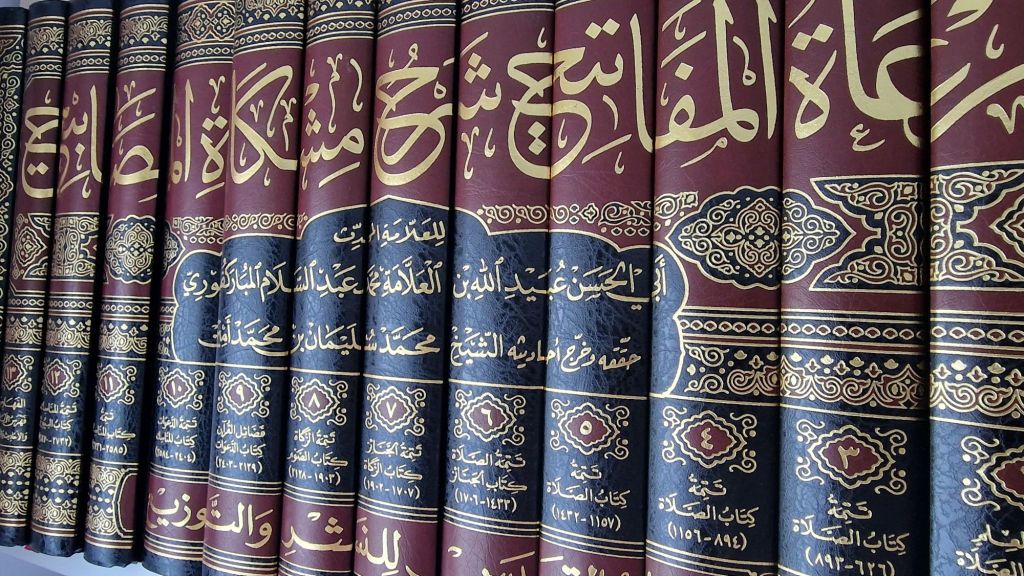
(Abridged, Mir’āt al-Mafātīh Sharh Mishkāt al-Masābīh 8/139-149)
Imām Al-Ithyūbī said:
“The Second Issue: Regarding its benefits:
- The clarification of the excellence of fasting.
- The establishment of the attribute of speech for Allāh The Most-High — that He speaks when He wills, and speaks to whom He wills with what He wills — and that His speech is not restricted to the Noble Qurʾān. And this is what is called the Hadīth Qudsī, which is the speech of Allāh The Most-High in reality. And the difference between it and the Qurʾān is that the Qurʾān is an act of worship to recite, unlike this.
- That acts of worship differ in terms of reward.
- That the extent of the reward of fasting is known by none except Allāh The Most-High.
- That the fasting person has joy in this world and the next.
- That the breath-change of the fasting person’s mouth is greater than the blood of the martyr — for the blood of the martyr’s smell is likened to the scent of musk, while the breath-change of the fasting person’s mouth is described as more pleasing (than musk itself). However, it does not necessarily follow from this that fasting is superior to martyrdom, for reasons that are not hidden.
The Fifth Issue:
Al-Hāfidh Walī al-Dīn, may Allāh The Most-High have mercy on him, said:
There is disagreement regarding the meaning of this breath-change being more pleasing than the scent of musk — after agreement that He, Glorified and Most High, is exalted above finding pleasant smells pleasing and foul smells disgusting, for that is a characteristic of (living) creatures which have natures that incline toward something and find it pleasing, and recoil from something and find it repugnant — holding the following opinions:
The first: Al-Māzarī said: It is a metaphor and a figurative expression…
The second: That its meaning is that Allāh The Most-High will reward him in the next life, such that his breath becomes more pleasing than the scent of musk…
The third: That the meaning is that the possessor of the breath-change will obtain a reward greater than the scent of musk (is great) to us…
The fourth: That the meaning is that (Allāh) reckons the smell of the breath-change and stores it for (the fasting person) as it is…
The fifth: That the meaning is that the breath-change carries more reward than musk — given that (the use of) musk is recommended for Fridays, the two ʿĪds, gatherings of hadīth and remembrance, and other gatherings of goodness. This was said by al-Dāwūdī, Ibn al-ʿArabī, the author of “al-Mufhim,” and some of the Shāfiʿīs. Al-Nawawī said: This is the most correct opinion.
The sixth: The author of “al-Mufhim” said: It is possible that this is with respect to the angels — that they find the smell of the breath-change more pleasant than the scent of musk. End of the words of Walī al-Dīn.
The compiler (i.e. Imām Al-Ithyūbī) — may Allāh The Most-High pardon him — said: All of these opinions are void, with no trace of knowledge supporting them — rather, they are built upon the whims of corrupt desires and the imagined, stale (notion of) likening (Allāh to creation). And none of them has any basis from the Salaf; rather, they all came from the later Ashāʿirah and those who followed their path.
For when Allāh, Glorified be He, revealed to His Messenger (ﷺ): “The breath-change of the fasting person’s mouth is more pleasing to Allāh than the scent of musk” — He did not command him to clarify that it is among the ambiguous (mutashābih) texts, nor that its apparent meaning is not intended, nor that its interpretation is such-and-such. Yet He the Most High is the One who said to him: “And We have sent down to you the Remembrance that you may make clear to the people what was sent down to them” (al-Nahl: 44). And the Prophet (ﷺ), when he conveyed this report, did not address the supposed problem nor answer it. Nor did the noble Companions, may Allāh be pleased with them — who were the most knowledgeable of people in the Arabic language and in the objectives of Islamic law after their Prophet (ﷺ) — when they heard the hadīth, find any problem in it, nor did they ask about its interpretation. And likewise the Tābiʿūn who followed them in goodness, may Allāh the Most High have mercy on them, followed their approach. Does what was sufficient for them not suffice us?
So, O people of reason — O fair-minded ones whose minds have not been coloured by the fantasies of the philosophers and the illusions of the theologians (mutakallimīn): it is the duty of every Muslim, when he hears any of the texts, to receive it with acceptance, and not to take it in every direction that his soul imagines — for these texts came only from the All-Knowing, All-Wise, who knows best what it is permissible to attribute to Him. And the Prophet (ﷺ) says nothing but the truth, as Allāh the Most High said: “Nor does he speak from (his own) desire. It is not but a revelation revealed” (al-Najm: 3–4).
And in summary: what is established as being attributed to Allāh the Most High — whether in His Mighty Book or in an authentic hadīth of His Messenger — must be accepted and understood according to its apparent meaning in the sense that Allāh The Most-High intended, without likening (Him to creation), without drawing equivalences, without (distorting) interpretation (taʾwīl), and without negation (taʿtīl).”
(Abridged, Sharh Sunan al-Nasā’ī 21/68-75)
 fawaaids.com